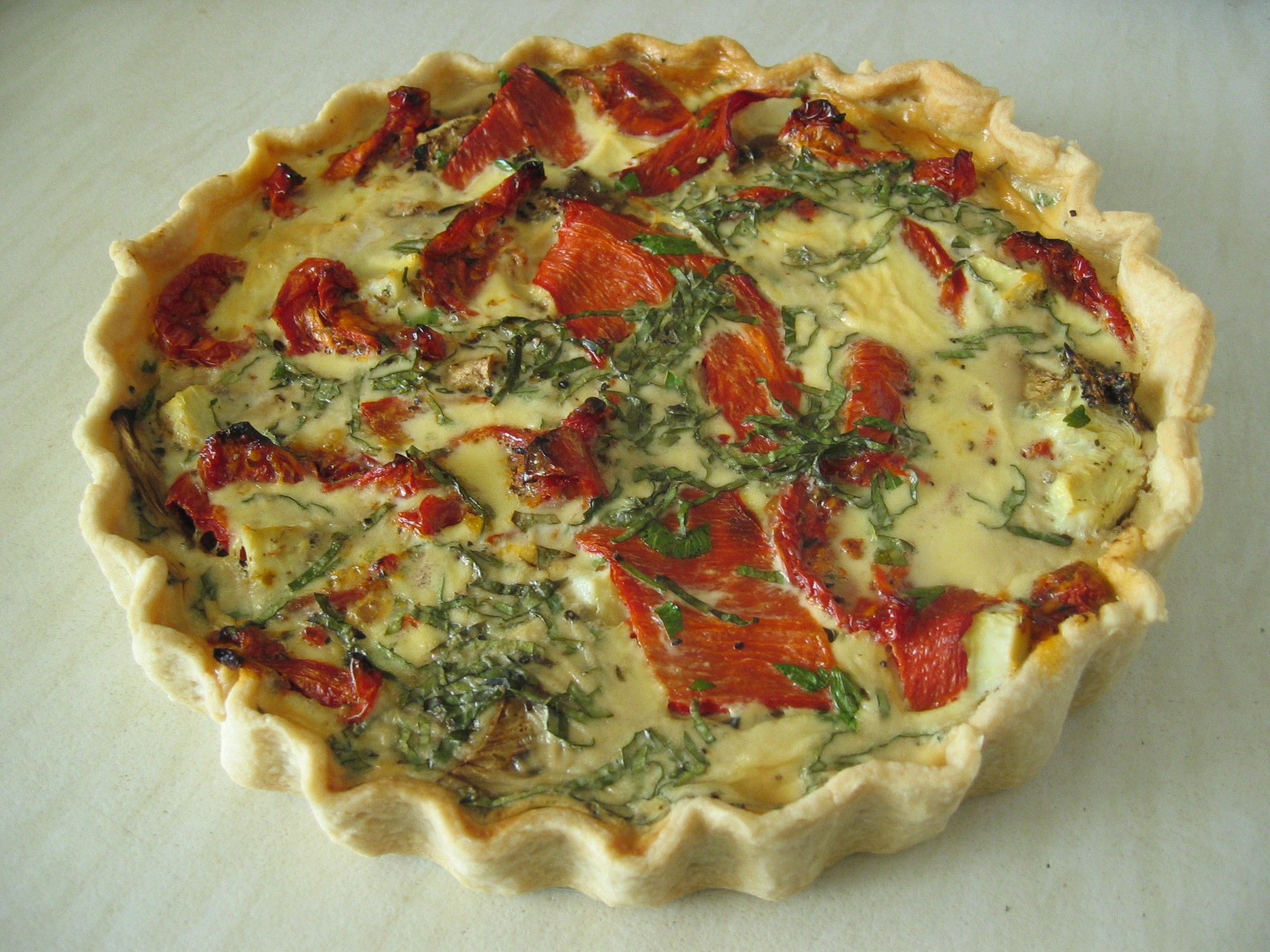
Mediterranean Roasted Vegetable Quiche
Introduction
Quiche has French roots, but this version is unmistakably Mediterranean — filled with roasted zucchini, bell peppers, sun-dried tomatoes, Kalamata olives, and crumbled feta cheese, then bound in a silky egg and cream custard that sets beautifully in the oven. It’s the kind of dish that bridges the gap between the egg-centric eating of the eastern Mediterranean and the custard-pastry traditions of southern France and northern Italy.
What makes a quiche Mediterranean rather than French is less about technique and more about what goes inside: roasted vegetables instead of bacon, feta instead of Gruyère, olive oil in the pastry instead of butter, and herbs like oregano and fresh dill that speak the language of Greece and the Levant. The result is brighter, lighter, and more vegetable-forward than a classic quiche Lorraine, while retaining all of the silky, satisfying richness that makes quiche so universally loved.
This dish works as a weekend brunch centerpiece, a light weekday dinner with a green salad, or an elegant component of a larger Mediterranean spread. It slices cleanly, keeps well in the refrigerator, and is served beautifully at room temperature — making it ideal for entertaining.
Why This Fits the Mediterranean Diet
The Mediterranean diet places eggs as a regular, moderate protein source — approximately 4–7 eggs per week in the traditional pattern. This quiche makes that easy: one slice provides the nourishment of 1–2 eggs along with two or three servings of roasted vegetables. The pastry is made with olive oil rather than butter (a simple, lower-saturated-fat swap), and the filling emphasizes vegetables, herbs, and cheese over meat.
Health Benefits
Eggs — complete protein and choline: Eggs are one of nature’s most complete proteins, containing all essential amino acids. They’re also the richest dietary source of choline, essential for liver function, brain development, and metabolism. The yolk contains fat-soluble vitamins A, D, E, and K2.
Roasted vegetables — concentrated nutrition: Roasting vegetables at high heat caramelizes their natural sugars and concentrates their nutrients, making them more flavorful and arguably more satisfying than raw. Zucchini provides vitamin C; bell peppers are extraordinarily rich in vitamin C (a red bell pepper has 3× the vitamin C of an orange); tomatoes provide lycopene.
Feta’s calcium and probiotics: Traditional feta, made from sheep’s and goat’s milk, provides calcium and may contain beneficial bacteria from its brine-aging process. It’s naturally lower in calories than many hard cheeses.
Olive oil pastry: Using extra virgin olive oil in place of butter in the crust reduces saturated fat significantly while adding Mediterranean monounsaturated fats and polyphenols.
Ingredients (Serves 6–8)
For the olive oil crust:
For the roasted vegetable filling:
For the custard:
Finishing:
Equipment Needed
Step-by-Step Instructions
1. Roast the vegetables. Preheat oven to 425°F (220°C). Toss zucchini, bell peppers, and red onion with olive oil, oregano, salt, and pepper on a rimmed baking sheet. Spread in a single layer — don’t crowd them or they’ll steam. Roast 20–25 minutes until tender and caramelized at the edges. Remove and let cool. Reduce oven to 375°F (190°C).
2. Make the olive oil crust. In a bowl, whisk flour and salt. Drizzle in the olive oil and stir with a fork until the mixture looks like coarse crumbs — it will be a bit crumbly, unlike butter pastry. Add ice water 1 tablespoon at a time, stirring, until the dough just comes together into a ball. Press into a flat disk, wrap in plastic, and rest 10–15 minutes.
3. Press the crust into the pan. Roll or simply press the dough into your tart pan with your fingers — this olive oil crust is very forgiving and press-in works perfectly. Press evenly up the sides. Prick the bottom all over with a fork.
4. Blind bake the crust. Line the crust with parchment and fill with pie weights or dried beans. Bake at 375°F for 15 minutes. Remove weights and parchment, bake 5 more minutes until the base is lightly golden and no longer raw-looking. Remove from oven.
5. Make the custard. Whisk eggs, cream, salt, pepper, and nutmeg together in a bowl until completely smooth and uniform in color.
6. Assemble the quiche. Scatter the roasted vegetables over the blind-baked crust. Add the sun-dried tomatoes and olives. Crumble the feta evenly over the top. Scatter fresh dill and parsley. Pour the custard slowly and evenly over everything — it will settle between the vegetables.
7. Bake. Bake at 375°F for 30–35 minutes until the custard is set at the edges but has a very slight wobble in the center, like just-set Jell-O. The center will firm up as it cools. Do not overbake — a dry quiche is a sad quiche.
8. Cool before slicing. Rest at room temperature for at least 15 minutes before cutting. This allows the custard to fully set and makes clean slices possible.
Pro Tips & Variations
The center should wobble. Pull the quiche from the oven when it has a quarter-sized wobble in the very center. It will set completely as it rests. Overbaking until it’s fully firm in the oven guarantees a rubbery, weeping texture.
Roast vegetables the day before. The roasted vegetables can be made ahead, refrigerated, and used directly from the fridge. This makes assembly very fast.
Gruyère variation: Replace feta with shredded Gruyère for a more classic, French-style quiche. Use thyme instead of dill.
Add spinach: Sauté a handful of baby spinach until just wilted, squeeze out excess water, and add to the filling for more greens and iron.
Crustless option: Skip the pastry entirely. Grease the pan, add filling, pour custard over, and bake. It becomes a frittata-style baked egg dish — lower carb, equally delicious.
Nutritional Information (Per Serving, based on 8 slices)
Storage & Reheating
Quiche is one of the best meal-prep items in the Mediterranean repertoire — it keeps and reheats beautifully.
Refrigerator: Wrapped well, quiche keeps for 4–5 days. Flavors often improve by day 2.
Reheating: Place slices on a baking sheet and reheat at 325°F for 12–15 minutes until warmed through. Microwave works in a pinch (60–70% power, 90 seconds) but the crust softens.
Serving temperature: Excellent at room temperature, which makes it perfect for picnics, packed lunches, and buffet-style entertaining.
Freezer: Freeze individual slices wrapped tightly in plastic then foil for up to 2 months. Thaw overnight in the refrigerator, then reheat in the oven.
Pairing Suggestions
Frequently Asked Questions
Can I use store-bought pie crust?
Yes, absolutely. A pre-made refrigerated crust saves time and the quiche will still be excellent. Just blind bake before filling.
My quiche is watery after baking — what happened?
Watery quiche is almost always caused by vegetables that weren’t properly roasted (releasing water into the custard) or by adding raw vegetables without cooking them first. Always roast or sauté vegetables to remove excess moisture before they go into the quiche.
Can I make this dairy-free?
The custard can be made with full-fat coconut cream, though the flavor changes. Replace feta with dairy-free cheese. The texture will be slightly less silky but still good.
What is blind baking and why is it necessary?
Blind baking pre-cooks the pastry before adding the wet filling. Without it, the bottom crust is usually underdone and soggy. It takes 20 extra minutes but guarantees a properly cooked crust.
Can this be made in advance for a dinner party?
Quiche is an ideal dinner party dish because it must be made in advance. Bake the day before, refrigerate, and bring to room temperature an hour before serving. It slices more cleanly when cooled and re-sliced than when piping hot from the oven.
Tools & pantry for this recipe
A few things that make this easier. These are affiliate links, so we may earn a small commission at no extra cost to you; we only suggest what we’d actually use ourselves. See our editorial policy.