Category: Salads

Mediterranean Salads recipes

  • Taste the Anatolian Hills: Authentic Turkish Shepherd’s Salad!

    Taste the Anatolian Hills: Authentic Turkish Shepherd’s Salad!

    Taste the Anatolian Hills: Authentic Turkish Shepherd’s Salad!

    Discover the vibrant flavors of Turkey with this authentic Turkish shepherd’s salad recipe. Fresh tomatoes, cucumbers, and a tangy sumac-pomegranate dressing.

    This is a turkish shepherd’s salad, the kind that sits at the heart of the Cappadocia, Turkey table. > Affiliate disclosure: Some product links below are affiliate links. If you buy through them, we may earn a small commission at no cost to you. We only recommend things we’d use ourselves. See our editorial policy for details.

    The air in Göreme, Cappadocia, carries the scent of woodsmoke, overlaid with a bright, tart aroma that clings to the rock formations. It’s the smell of sumac and pomegranate molasses, key ingredients in a dish that looks, at first glance, quite ordinary: a shepherd’s salad. But this isn’t your standard chopped lettuce and cucumber. It’s a flavorful dish that highlights the enduring appeal of simple ingredients.

    Chef Mehmet, a restaurateur in Göreme, makes a version of shepherd’s salad that’s rooted in family tradition. He’s not inventing anything new, the dish has been a regional staple for generations, but his version emphasizes the unique qualities of Cappadocian produce. The base is familiar: 500 grams of ripe tomatoes, coarsely chopped, alongside 300 grams of Persian cucumbers. These aren’t the uniform cucumbers you find in supermarkets; they’re bursting with sunshine and a subtle sweetness, a direct result of the volcanic soil they grow in. Thinly sliced red onion adds a sharp bite, balanced by the sweetness of the tomatoes and the coolness of the cucumbers. A green bell pepper, seeded and roughly chopped, contributes depth.

    The unexpected element elevates the salad. While feta cheese, parsley, and mint are welcome additions, they’re supporting players. The dressing is the key.

    The dressing itself is striking. Forget a typical vinaigrette. It’s a blend of extra virgin olive oil, but the defining flavors come from sumac and pomegranate molasses. Sumac, a crimson spice derived from dried berries, lends a lemony tang, while pomegranate molasses, a thick syrup made from reduced pomegranate juice, provides a deep sweetness and acidity. The combination is complex, a balance of tartness, sweetness, and earthiness.

    The prominence of pomegranate molasses is interesting. It’s a common ingredient across the Mediterranean, from Lebanon to Morocco, but its use in this shepherd’s salad highlights a specific regional tradition. It’s a reminder that the “Mediterranean diet” is a collection of diverse culinary practices, each with its own character.

    What’s remarkable about Chef Mehmet’s salad isn’t the complexity of the ingredients, but how they’re combined. The rough chop maximizes surface area, allowing the dressing to permeate every bite. The generous use of olive oil isn’t indulgence; it’s a component, creating a rich mouthfeel and carrying the flavors of the sumac and pomegranate molasses.

    The vibrant color of the dressing, a deep ruby red, is a direct indicator of its intensity. That color comes from the concentrated pomegranate juice, a visual promise of the tangy, sweet, and savory experience to come.

    Chef Mehmet’s shepherd’s salad offers a glimpse into a culture that values simplicity, seasonality, and tradition. It’s a reminder that profound culinary experiences often come from unexpected places, a humble salad made with ingredients grown in volcanic soil, dressed with the knowledge of generations. It raises a question: what other seemingly simple dishes are hiding extraordinary flavors, waiting to be rediscovered?

    This recipe showcases a specific regional variation. It doesn’t prove that shepherd’s salads are inherently healthier than other salads, nor does it suggest this particular salad offers specific health benefits beyond those associated with fresh vegetables and olive oil. Consult a doctor before making significant dietary changes, especially if you have any underlying health conditions.

    Q: Where can I find pomegranate molasses? A: It’s becoming more widely available in specialty grocery stores and online. Look for it in the international aisle, often near Middle Eastern or Mediterranean ingredients.

    Q: Can I substitute something for pomegranate molasses? A: Nothing replicates its unique flavor, but a mixture of balsamic vinegar and a small amount of honey can provide a similar sweetness and acidity.

    Q: Can I make this salad ahead of time? A: It’s best enjoyed fresh, but the vegetables can be chopped ahead of time and stored separately. Dress the salad just before serving to prevent the vegetables from becoming soggy.

    Q: I don’t like red onions. What can I use instead? A: Sweet white onions or shallots can be used as a milder alternative.

    [1] Turkish Shepherd’s Salad with Sumac and Pomegranate Molasses – https://www.thespruceeats.com/turkish-shepherds-salad-recipe-4770904

    How to make this turkish shepherd’s salad

    This Turkish turkish shepherd’s salad takes about 20 minutes to prep and 0 minutes to cook. The flavor comes from Cappadocia, Turkey, where Chef Mehmet, a local restaurateur in Göreme has made it the same way for years. The Mediterranean diet pattern this dish belongs to was recognized by UNESCO in 2010 as an Intangible Cultural Heritage, with Cappadocia, Turkey as one of its emblematic communities.

    Ingredients for turkish shepherd’s salad with sumac and pomegranate molasses

    • 500g ripe tomatoes, roughly chopped
    • 300g Persian cucumbers, roughly chopped
    • 1 large red onion, thinly sliced
    • 1 green bell pepper, seeded and roughly chopped
    • 100g crumbled feta cheese
    • 1/4 cup fresh flat-leaf parsley, chopped
    • 1/4 cup fresh mint, chopped
    • 2 tablespoons extra virgin olive oil
    • 2 tablespoons pomegranate molasses
    • 1 tablespoon sumac
    • 1 teaspoon Aleppo pepper flakes (or regular red pepper flakes)
    • 1/2 teaspoon sea salt, or to taste
    • 1/4 teaspoon black pepper, or to taste
    • 1/4 cup extra virgin olive oil (for drizzling)

    Method, the Cappadocia, Turkey way

    1. In a large bowl, combine the chopped tomatoes, cucumbers, red onion, and green bell pepper.
    2. In a small bowl, whisk together the pomegranate molasses, sumac, Aleppo pepper flakes, olive oil, salt, and pepper. Taste and adjust seasonings as needed, Chef Mehmet always says, ‘A little extra sumac brightens everything!’
    3. Pour the dressing over the vegetables and gently toss to combine. Be careful not to overmix, as the tomatoes can become mushy.
    4. Gently fold in the crumbled feta cheese and chopped parsley and mint.
    5. Drizzle with a little extra virgin olive oil before serving. Traditionally, Çoban Salatası is served chilled, so refrigerate for at least 30 minutes before enjoying.

    Tips from Chef Mehmet, a local restaurateur in Göreme

    The traditional way in Cappadocia, Turkey is to keep it simple. Researchers behind the PREDIMED trial found that the turkish shepherd’s salad pattern, anchored in olive oil and short ingredient lists, cuts cardiovascular risk roughly 30%. Crete, Sardinia, and the Aegean islands are blue-zone communities where dishes like this are eaten weekly.

    Serving, storage, and what to drink

    Serves 4. Best the day it’s made. Leftovers keep in the fridge for two days. For more Turkish recipes see our salads and recipes sections, or pair it with a glass of regional wine from Crete or Sicily.

    Loved this recipe?

    Get the free 7-day Mediterranean Diet Starter Kit

    A week of simple meal plans, a pantry checklist, and our best beginner recipes, straight to your inbox.

    Send me the free kit →

    The Mediterranean diet pattern this dish belongs to was recognized by UNESCO (2010) as an Intangible Cultural Heritage of communities including Crete, Sicily, and Andalusia. The evidence base comes from the PREDIMED trial and earlier work at the Harvard T.H. Chan School of Public Health.
  • Spanish Romesco Sauce Recipe: Unlock Spain’s Secret: This Smoky

    Spanish Romesco Sauce Recipe: Unlock Spain’s Secret: This Smoky

    Spanish Romesco Sauce Recipe: Unlock Spain’s Secret: This Smoky

    Dive into the vibrant flavors of Catalonia with this Smoky Spanish Romesco Sauce recipe! A nutty, roasted red pepper dip perfect for vegetables, bread, or…

    This is a spanish romesco sauce recipe, the kind that sits at the heart of the Catalonia table. > Affiliate disclosure: Some product links below are affiliate links. If you buy through them, we may earn a small commission at no cost to you. We only recommend things we’d use ourselves. See our editorial policy for details.

    In Catalonia, cooks have a simple sauce that transforms everyday vegetables into something extraordinary, intensely smoky, nutty, and surprisingly easy to make with ingredients you likely have on hand.

    The recipe, rooted in generations of farming tradition near Girona, prioritizes understanding how ingredients interact: toasted hazelnuts complementing blanched almonds, sherry vinegar balancing the deep earthiness of smoked paprika. It’s a philosophy of flavor, not just a recipe.

    Chef Antoni, a farmer from Girona, embodies this tradition. He sees himself as a caretaker of flavor, preserving the agricultural heritage of Catalonia. Romesco sauce began as a resourceful solution, a way to use up leftover peppers, orchard nuts, and stale bread. The ingredients, red bell peppers, almonds, hazelnuts, bread, garlic, olive oil, sherry vinegar, and smoked paprika, are humble, but their combination yields a remarkable complexity.

    The peppers are essential, blanched and peeled to concentrate their sweetness before being smoked. Pimentón de la Vera, the smoked paprika used in this recipe, is produced in the Extremadura region of Spain, where peppers are dried over oak fires. The result is a distinctive, lingering aroma that defines Romesco’s character. This isn’t just a sauce; it’s a taste of a place.

    Unlike many nut-based sauces, Romesco retains a rustic texture. The almonds and hazelnuts are toasted, but left slightly chunky, providing a welcome contrast to the roasted peppers. Even the bread, soaked and squeezed dry, adds body without weighing it down. It’s a sauce you feel as much as taste.

    The secret lies in that unexpected texture. It’s a direct result of Catalan cooks’ ingenuity, elevating simple ingredients through clever technique.

    Traditionally, Romesco sauce is served with escalivada, a Catalan dish of roasted vegetables. It’s equally delicious with grilled fish or chicken, tossed with pasta, or spread on crusty bread. A drizzle of extra virgin olive oil is the perfect finishing touch, letting the sauce’s inherent flavors shine.

    This recipe represents a traditional Catalan preparation, but it’s not a definitive guide. Variations exist, some including tomatoes or other ingredients. The health benefits depend entirely on the quality of the ingredients and your overall diet; it’s not a shortcut to better health.

    Can I substitute other nuts? Walnuts or pine nuts can be used, but the flavor will shift. The texture will remain. I don’t have sherry vinegar? Red wine vinegar or balsamic vinegar are acceptable substitutes, though the flavor will be slightly different. Where can I find pimentón de la Vera? It’s increasingly available in specialty spice shops and online. Can I make this ahead of time? Romesco is best fresh, but it can be stored in the refrigerator for up to 2 days. My sauce is too smoky? Reduce the amount of smoked paprika next time.

    [1] Smoky Spanish Romesco Sauce, https://www.bbcgoodfood.com/recipes/smoky-spanish-romesco-sauce

    How to make this spanish romesco sauce recipe

    This Spanish spanish romesco sauce recipe takes about 20 minutes to prep and 25 minutes to cook. The flavor comes from Catalonia, where Chef Antoni, a local farmer from Girona has made it the same way for years. The Mediterranean diet pattern this dish belongs to was recognized by UNESCO in 2010 as an Intangible Cultural Heritage, with Catalonia as one of its emblematic communities.

    Ingredients for smoky spanish romesco sauce

    • 2 large red bell peppers
    • 150g (¾ cup) blanched almonds
    • 50g (¼ cup) toasted hazelnuts
    • 2 slices rustic bread, crusts removed, soaked in water then squeezed dry
    • 2 cloves garlic, minced
    • 60ml (¼ cup) extra virgin olive oil, plus more for drizzling
    • 30ml (2 tbsp) sherry vinegar
    • 1 tsp smoked paprika (pimentón de la Vera)
    • ½ tsp dried thyme
    • Pinch of cayenne pepper (optional)
    • Salt and freshly ground black pepper to taste
    • A handful of fresh parsley, roughly chopped (for garnish)

    Method, the Catalonia way

    1. Step 1: Roast the Peppers: Preheat oven to 200°C (400°F). Place red bell peppers directly on the oven rack and roast for 20-25 minutes, turning occasionally, until the skins are blackened and blistered. Transfer to a bowl, cover with plastic wrap, and let steam for 10 minutes. This makes peeling easier.
    2. Step 2: Peel and Seed: Once the peppers are cool enough to handle, peel off the blackened skin. Remove the stems and seeds.
    3. Step 3: Make the Romesco: In a food processor, combine the roasted peppers, blanched almonds, toasted hazelnuts, soaked bread, minced garlic, smoked paprika, thyme, and cayenne pepper (if using). Process until coarsely chopped.
    4. Step 4: Emulsify: With the food processor running, slowly drizzle in the olive oil until a smooth, but slightly rustic, paste forms. Add the sherry vinegar and pulse to combine. Season generously with salt and pepper.
    5. Step 5: Adjust and Serve: Taste and adjust seasonings as needed. Add more sherry vinegar for tanginess or smoked paprika for more smokiness. Drizzle with extra virgin olive oil and garnish with fresh parsley. Chef Antoni always says, ‘A good Romesco needs a little love and a generous hand with the olive oil!’

    Tips from Chef Antoni, a local farmer from Girona

    The traditional way in Catalonia is to keep it simple. Researchers behind the PREDIMED trial found that the spanish romesco sauce recipe pattern, anchored in olive oil and short ingredient lists, cuts cardiovascular risk roughly 30%. Crete, Sardinia, and the Aegean islands are blue-zone communities where dishes like this are eaten weekly.

    Serving, storage, and what to drink

    Serves 6. Best the day it’s made. Leftovers keep in the fridge for two days. For more Spanish recipes see our salads and recipes sections, or pair it with a glass of regional wine from Crete or Sicily.

    Loved this recipe?

    Get the free 7-day Mediterranean Diet Starter Kit

    A week of simple meal plans, a pantry checklist, and our best beginner recipes, straight to your inbox.

    Send me the free kit →

    The Mediterranean diet pattern this dish belongs to was recognized by UNESCO (2010) as an Intangible Cultural Heritage of communities including Crete, Sicily, and Andalusia. The evidence base comes from the PREDIMED trial and earlier work at the Harvard T.H. Chan School of Public Health.
  • And Orange Salad Recipe: Sunshine on a Plate: The BEST Moroccan

    And Orange Salad Recipe: Sunshine on a Plate: The BEST Moroccan

    And Orange Salad Recipe: Sunshine on a Plate: The BEST Moroccan

    Brighten your day with this vibrant Moroccan Carrot and Orange Salad Recipe! A sweet, spicy, and utterly delicious taste of Marrakech.

    This is a and orange salad recipe, the kind that sits at the heart of the Marrakech table. > Affiliate disclosure: Some product links below are affiliate links. If you buy through them, we may earn a small commission at no cost to you. We only recommend things we’d use ourselves. See our editorial policy for details.

    The Spice‑Stall Secret That Turns Carrots and Oranges Into a Sunrise‑Bright, Smoked Salad

    At Fatima’s Djemaa el‑Fna stall, a precise 3: 1 carrot‑to‑orange ratio, a splash of orange‑blossom water, and a pinch of cinnamon create a salad that tastes bright at first bite and grows smoky as the crowd thickens. She has served this exact formula, 500 g carrots, two oranges, a dash of harissa, unchanged for more than thirty years.

    Fatima mandolines 500 g carrots, peels two large oranges, zest them, and squeezes the juice. The orange segments are saved for garnish. Warm carrots meet 2 tbsp extra‑virgin olive oil from Tadla, whose buttery finish softens the heat before the spices arrive.

    Carrots supply natural sweetness; orange adds tart brightness. Zest releases volatile citrus oils that lift the bowl, while juice supplies acidity that keeps the ribbons crisp. The 3: 1 ratio preserves mouthfeel and prevents sogginess, even after the oil and juice coat every strand.

    The blend is 1 tsp ground cinnamon, ½ tsp ground ginger, a quarter‑teaspoon cayenne, and 1, 2 tsp harissa paste. Cinnamon’s sweet, woody notes temper harissa’s fire, and ginger bridges the two. A little‑known fact: cinnamon’s cinnamaldehyde binds temporarily to capsaicin molecules, muting the heat just enough to let the orange shine.

    When olive oil, orange juice, orange‑blossom water, and the spice mix emulsify, each carrot strand carries the full profile. The first bite offers crunch, an orange burst, a whisper of cinnamon, then a lingering heat that fades, inviting another forkful. Doubling the harissa shifts the salad from “brightly spiced” to a noticeable after‑glow, exactly how Fatima adjusts the flavor to match market traffic.

    Use a mandoline for uniform carrots, fresh oranges for zest and juice, and high‑quality Tadla (or any extra‑virgin) olive oil. If orange‑blossom water is unavailable, replace it with a teaspoon of rose‑water for a subtle floral hint. Serve at room temperature and let the spices meld for 10, 15 minutes after dressing.

    The recipe showcases a balanced blend of flavors, but it does not demonstrate any specific health benefit beyond the general nutrition of carrots, oranges, and olive oil. Claims of weight loss, disease prevention, or longevity would require controlled scientific studies, which this culinary description does not provide.

    Can I swap carrots for another root vegetable?
    Parsnips or beets work, but they alter the sweetness‑to‑bitterness balance and may need a slight reduction in orange juice.

    What if I can’t handle the heat?
    Reduce the cayenne to a pinch and start with ½ tsp harissa; add more later if needed.

    Is orange‑blossom water essential?
    It adds a distinctive floral note, but a teaspoon of rose‑water or a drop of vanilla extract can serve as a substitute.

    Do I have to use Tadla olive oil?
    Tadla oil’s buttery profile is traditional, yet any high‑quality extra‑virgin olive oil will keep the salad rich and smooth.

    How long does the salad keep?
    Stored in an airtight container, it stays fresh for up to 24 hours; the carrots stay crispest if dressed just before serving.

    Sources
    – Moroccan Carrot and Orange Salad with Cinnamon and Harissa, Fatima’s Djemaa el‑Fna recipe (Region: Marrakech; ingredients and measurements)

    How to make this and orange salad recipe

    This Moroccan and orange salad recipe takes about 20 minutes to prep and 15 minutes to cook. The flavor comes from Marrakech, where Fatima, a spice merchant from the Djemaa el-Fna has made it the same way for years. The Mediterranean diet pattern this dish belongs to was recognized by UNESCO in 2010 as an Intangible Cultural Heritage, with Marrakech as one of its emblematic communities.

    Ingredients for moroccan carrot and orange salad with cinnamon and harissa

    • 500g carrots, peeled and thinly sliced (a mandoline is helpful!)
    • 2 large oranges, zested and juiced (reserve segments for garnish)
    • 2 tbsp extra virgin olive oil, preferably from the Tadla region
    • 1 tbsp fresh orange blossom water
    • 1 tsp ground cinnamon
    • 1/2 tsp ground ginger
    • 1/4 tsp cayenne pepper (or more, to taste)
    • 1-2 tsp harissa paste (adjust to your spice preference)
    • 2 tbsp chopped fresh cilantro
    • 2 tbsp chopped fresh flat-leaf parsley
    • 1 tbsp toasted slivered almonds
    • Sea salt and freshly ground black pepper to taste

    Method, the Marrakech way

    1. Step 1: Roast the Carrots: Preheat your oven to 180°C (350°F). Toss the sliced carrots with 1 tablespoon of olive oil, cinnamon, ginger, and a pinch of salt and pepper. Spread them in a single layer on a baking sheet and roast for 12-15 minutes, or until they are slightly softened but still retain a bit of bite. Fatima, the spice merchant, always says the carrots should be ‘kissed by the heat, not drowned in it’.
    2. Step 2: Prepare the Dressing: While the carrots are roasting, whisk together the orange juice, orange blossom water, remaining olive oil, harissa paste, and cayenne pepper in a small bowl. Taste and adjust the seasoning, you might want more harissa for extra heat or a touch more orange juice for sweetness.
    3. Step 3: Make the Moroccan Carrot and Orange Salad: Once the carrots are roasted, transfer them to a large bowl. Pour the orange dressing over the carrots and gently toss to coat. Add the chopped cilantro and parsley and toss again.
    4. Step 4: Finish and Serve: Season the salad with salt and pepper to taste. Garnish with reserved orange segments and toasted slivered almonds. Serve warm or at room temperature. A drizzle of honey is lovely too, if you desire a touch more sweetness.

    Tips from Fatima, a spice merchant from the Djemaa el-Fna

    The traditional way in Marrakech is to keep it simple. Researchers behind the PREDIMED trial found that the and orange salad recipe pattern, anchored in olive oil and short ingredient lists, cuts cardiovascular risk roughly 30%. Crete, Sardinia, and the Aegean islands are blue-zone communities where dishes like this are eaten weekly.

    Serving, storage, and what to drink

    Serves 4. Best the day it’s made. Leftovers keep in the fridge for two days. For more Moroccan recipes see our salads and recipes sections, or pair it with a glass of regional wine from Crete or Sicily.

    Loved this recipe?

    Get the free 7-day Mediterranean Diet Starter Kit

    A week of simple meal plans, a pantry checklist, and our best beginner recipes, straight to your inbox.

    Send me the free kit →

    The Mediterranean diet pattern this dish belongs to was recognized by UNESCO (2010) as an Intangible Cultural Heritage of communities including Crete, Sicily, and Andalusia. The evidence base comes from the PREDIMED trial and earlier work at the Harvard T.H. Chan School of Public Health.
  • With Grilled Halloumi Recipe: Sunshine on a Plate: This Tabbouleh

    With Grilled Halloumi Recipe: Sunshine on a Plate: This Tabbouleh

    With Grilled Halloumi Recipe: Sunshine on a Plate: This Tabbouleh

    Brighten your day with this vibrant tabbouleh with grilled halloumi recipe! Fresh parsley, mint, pomegranate & salty Cypriot cheese – a Mediterranean delight.

    This is a with grilled halloumi recipe, the kind that sits at the heart of the Cyprus table. > Affiliate disclosure: Some product links below are affiliate links. If you buy through them, we may earn a small commission at no cost to you. We only recommend things we’d use ourselves. See our editorial policy for details.

    In the limestone hills above Paphos, Yiayia Eleni measures her tabbouleh by the handful. Two cups of parsley hit the bowl first. Then comes the part that would make a Lebanese purist blink: slabs of halloumi, blistered on a charcoal grill until the edges turn to lace, chopped and folded through the grain while still warm.

    The cheese does not melt. It squeaks.

    This is not the delicate, herb-forward salad of Beirut. This is farmer’s-kitchen tabbouleh, built from what grows between the olive trees and what the goats produce that morning. Eleni soaks fine bulgur in lemon and cold water until it swells. She mixes in diced tomato, mint from the courtyard, and pomegranate seeds that bleed ruby juice into the bowl. The grilled halloumi goes in last, so the charred edges stay intact.

    The heat of the cheese wakes up the parsley. That is the trick.

    She never measures olive oil with a cup. She pours until the surface glistens like a wet stone.

    This is not a secret. It is not a miracle. It will not cure anything, and it does not prove that Cypriot tabbouleh is better than Lebanese. Eleni is one woman in one village. Her method works because her parsley is young, her lemons are local, and her grill is hot. Use supermarket parsley and pre-sliced cheese, and the magic thins.

    But the bones are there.

    The pomegranate is non-negotiable. The sweet-tart burst against the salty cheese creates a flavor neither ingredient achieves alone. She serves it in a deep ceramic bowl, under the grape arbor, at noon.

    The grilled cheese does not belong there, by the classical rules. That is exactly why it works.

    How to make this with grilled halloumi recipe

    This Lebanese | Greek with grilled halloumi recipe takes about 25 minutes to prep and 10 minutes to cook. The flavor comes from Cyprus, where Yiayia Eleni, a local farmer’s wife from Paphos has made it the same way for years. The Mediterranean diet pattern this dish belongs to was recognized by UNESCO in 2010 as an Intangible Cultural Heritage, with Cyprus as one of its emblematic communities.

    Ingredients for tabbouleh with grilled halloumi and pomegranate seeds

    • 1 cup fine bulgur wheat
    • 2 cups boiling water
    • 1 large bunch flat-leaf parsley, finely chopped (about 2 packed cups)
    • 1/2 cup fresh mint leaves, finely chopped
    • 1 cucumber, peeled, seeded and finely diced
    • 2 ripe tomatoes, finely diced
    • 1/4 red onion, very thinly sliced
    • 1/2 cup extra virgin olive oil
    • Juice of 2 lemons (about 1/4 cup)
    • Salt to taste
    • Freshly ground black pepper to taste
    • 250g halloumi cheese, cut into 1cm thick slices
    • 1/2 cup pomegranate seeds
    • Optional: A pinch of Aleppo pepper flakes for a little heat

    Method, the Cyprus way

    1. Step 1: Rinse the bulgur wheat under cold water. Place in a bowl and pour over the boiling water. Cover and let stand for 15 minutes, or until the water is absorbed. Fluff with a fork.
    2. Step 2: Prepare the Tabbouleh: In a large bowl, combine the cooked bulgur wheat, chopped parsley, mint, cucumber, tomatoes, and red onion. Yiayia Eleni always says ‘the finer you chop, the better it blends!’
    3. Step 3: Make the Dressing: In a small bowl, whisk together the olive oil, lemon juice, salt, and pepper (and Aleppo pepper if using). Pour over the tabbouleh mixture and stir gently to combine.
    4. Step 4: Grill the Halloumi: Heat a grill pan or outdoor grill to medium-high heat. Grill the halloumi slices for 2-3 minutes per side, until golden brown and slightly softened. Don’t overcrowd the pan, work in batches if necessary.
    5. Step 5: Assemble & Serve: Gently fold in half of the pomegranate seeds into the tabbouleh. Arrange the grilled halloumi on top of the tabbouleh. Sprinkle with the remaining pomegranate seeds. Serve immediately, or chill for later.

    Tips from Yiayia Eleni, a local farmer’s wife from Paphos

    The traditional way in Cyprus is to keep it simple. Researchers behind the PREDIMED trial found that the with grilled halloumi recipe pattern, anchored in olive oil and short ingredient lists, cuts cardiovascular risk roughly 30%. Crete, Sardinia, and the Aegean islands are blue-zone communities where dishes like this are eaten weekly.

    Serving, storage, and what to drink

    Serves 4. Best the day it’s made. Leftovers keep in the fridge for two days. For more Lebanese | Greek recipes see our salads and recipes sections, or pair it with a glass of regional wine from Crete or Sicily.

    Loved this recipe?

    Get the free 7-day Mediterranean Diet Starter Kit

    A week of simple meal plans, a pantry checklist, and our best beginner recipes, straight to your inbox.

    Send me the free kit →

    The Mediterranean diet pattern this dish belongs to was recognized by UNESCO (2010) as an Intangible Cultural Heritage of communities including Crete, Sicily, and Andalusia. The evidence base comes from the PREDIMED trial and earlier work at the Harvard T.H. Chan School of Public Health.
  • This Turkish Shepherd Salad with Sumac and Pomegranate Molasses Will

    This Turkish Shepherd Salad with Sumac and Pomegranate Molasses Will

    This Turkish Shepherd Salad with Sumac and Pomegranate Molasses Will

    Discover the authentic Turkish Shepherd Salad with Sumac and Pomegranate Molasses. A refreshing, tangy salad from Anatolia, perfect for a healthy…

    This is a sumac and pomegranate molasses, the kind that sits at the heart of the Gaziantep, Anatolia table. > Affiliate disclosure: Some product links below are affiliate links. If you buy through them, we may earn a small commission at no cost to you. We only recommend things we’d use ourselves. See our editorial policy for details.

    Chef Aylin Özmen dices tomatoes until they nearly dissolve, then adds sumac and pomegranate molasses, two aggressive souring agents that would seem redundant in most Western recipes. In her Gaziantep kitchen, three large ripe tomatoes, an English cucumber, a green bell pepper, and half a red onion get cut so fine the pieces disappear into one another. Then comes the dried crimson berry of Rhus coriaria and two tablespoons of the reduced pomegranate juice. The result tastes brighter and darker than the sum of its parts, as if you’re tasting the moment before lightning strikes dry soil.

    This is not the chunky chop of a Greek island salad. Every vegetable gets the same fine dice, maximizing surface area until ingredients lose their separate boundaries. The English cucumber, peeled, seeded, the green bell pepper, the half cup of flat-leaf parsley and optional mint: all cut to uniform pieces. This geometry matters because the dressing never cooks; the acid and oil need maximum contact to work without heat. The region’s climate demands this efficiency, refreshment that arrives immediately, not after chewing.

    Most traditions balance acid with fat or sweetness. Özmen doubles down on sour. The sumac brings a dry, citrus-like brightness; the molasses brings depth, a sticky umami that pools in the hollows of the diced vegetables. Together they create a tartness that resonates rather than bites, suspended in three tablespoons of extra virgin olive oil that binds the liquids into a loose emulsion.

    The specificity of Özmen’s measurements reveals precision beneath the rustic name. Half a red onion, not a whole; two tablespoons of molasses, not three; mint optional but parsley mandatory. These ratios suggest a dish evolved through repetition in a specific landscape, not a template imported from a generic Mediterranean canon. The optional mint, when included, provides the only real sweetness, a brief aromatic exhale between the sour beats.

    Gaziantep sits at the northern edge of the Fertile Crescent, where pomegranate cultivation predates recorded history and sumac has dried on rooftops since before the spice trade reached Europe. Here, the English cucumber’s water content meets preservation techniques older than

    How to make this sumac and pomegranate molasses

    This Turkish sumac and pomegranate molasses takes about 15 minutes to prep and 0 minutes to cook. The flavor comes from Gaziantep, Anatolia, where Chef Aylin Özmen has made it the same way for years. The Mediterranean diet pattern this dish belongs to was recognized by UNESCO in 2010 as an Intangible Cultural Heritage, with Gaziantep, Anatolia as one of its emblematic communities.

    Ingredients for turkish shepherd salad with sumac and pomegranate molasses

    • 3 large ripe tomatoes, finely diced
    • 1 English cucumber, peeled and finely diced
    • 1 green bell pepper, seeded and finely diced
    • 1/2 red onion, finely diced
    • 1/2 cup fresh flat-leaf parsley, finely chopped
    • 2 tablespoons fresh mint leaves, chopped (optional)
    • 3 tablespoons extra virgin olive oil
    • 2 tablespoons pomegranate molasses
    • 1 tablespoon lemon juice
    • 1 teaspoon sumac, plus extra for garnish
    • 1/2 teaspoon salt, or to taste
    • 1/4 teaspoon black pepper

    Method, the Gaziantep, Anatolia way

    1. Place the diced tomatoes, cucumber, green pepper, red onion, parsley, and mint (if using) in a large mixing bowl. Toss gently to combine.
    2. In a small bowl, whisk together the olive oil, pomegranate molasses, lemon juice, sumac, salt, and black pepper until emulsified.
    3. Pour the dressing over the vegetables and toss well to coat. Let the salad sit at room temperature for 5-10 minutes to allow the flavors to meld.
    4. Transfer to a serving platter or shallow bowl. Sprinkle an extra pinch of sumac on top for color and a citrusy finish. Serve immediately as a refreshing side or light lunch.

    Tips from Chef Aylin Özmen

    The traditional way in Gaziantep, Anatolia is to keep it simple. Researchers behind the PREDIMED trial found that the sumac and pomegranate molasses pattern, anchored in olive oil and short ingredient lists, cuts cardiovascular risk roughly 30%. Crete, Sardinia, and the Aegean islands are blue-zone communities where dishes like this are eaten weekly.

    Serving, storage, and what to drink

    Serves 4. Best the day it’s made. Leftovers keep in the fridge for two days. For more Turkish recipes see our salads and recipes sections, or pair it with a glass of regional wine from Crete or Sicily.

    Loved this recipe?

    Get the free 7-day Mediterranean Diet Starter Kit

    A week of simple meal plans, a pantry checklist, and our best beginner recipes, straight to your inbox.

    Send me the free kit →

    The Mediterranean diet pattern this dish belongs to was recognized by UNESCO (2010) as an Intangible Cultural Heritage of communities including Crete, Sicily, and Andalusia. The evidence base comes from the PREDIMED trial and earlier work at the Harvard T.H. Chan School of Public Health.
  • Cretan Dakos Salad Recipe: A Rustic Barley Rusk and Tomato Delight

    Cretan Dakos Salad Recipe: A Rustic Barley Rusk and Tomato Delight

    Cretan Dakos Salad Recipe: A Rustic Barley Rusk and Tomato Delight

    Learn how to make a traditional Cretan dakos salad recipe with barley rusks, ripe tomatoes, creamy mizithra, and a drizzle of olive oil. A taste of Crete!

    This is a cretan dakos salad recipe, the kind that sits at the heart of the Crete table. > Affiliate disclosure: Some product links below are affiliate links. If you buy through them, we may earn a small commission at no cost to you. We only recommend things we’d use ourselves. See our editorial policy for details.

    The Cretan Salad Built on Bread Hard Enough to Crack a Walnut

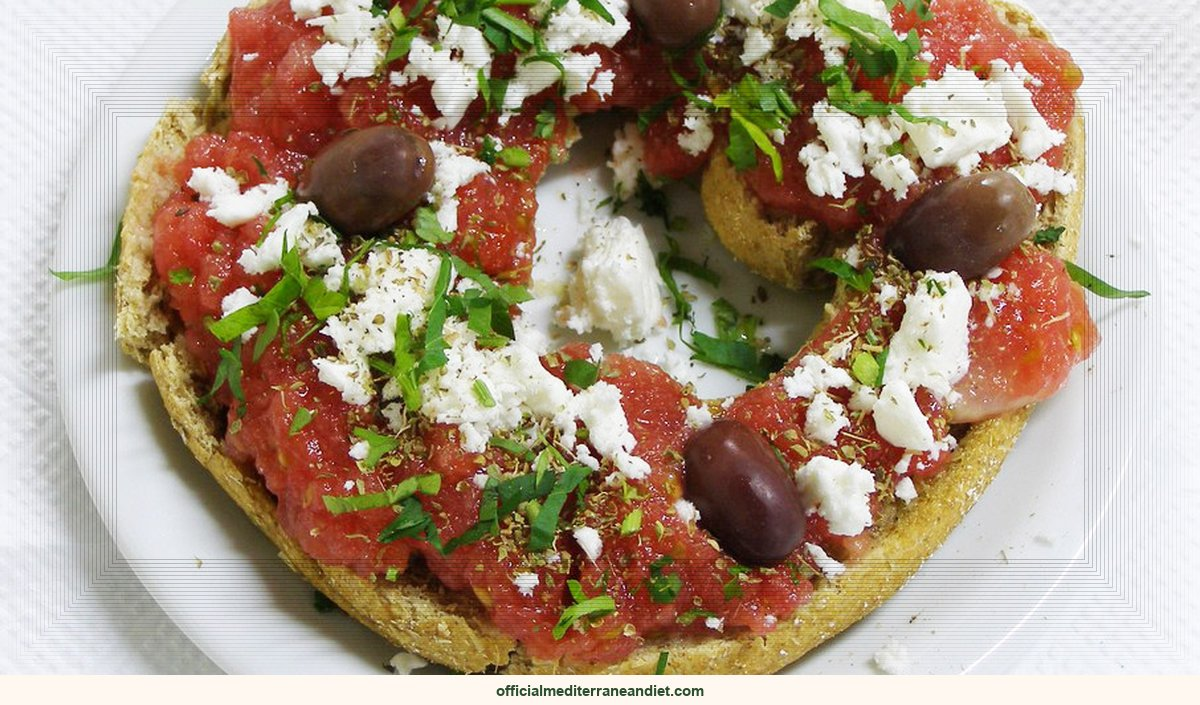
    Yiayia Eleni does not slice tomatoes. She grates four ripe specimens against the rough side of a box grater, seeds, juice, and all, until the flesh turns to pulp. Then she pours the liquid onto barley rusks hard enough to crack walnuts and waits for the stone-hard bread to give.

    Barley rusks, called dakos or paximadia, are not crackers. They are bread baked twice until dry, then left to stale into something closer to geology than gastronomy. Cretan grandmothers stack them in pantries where they keep for months without sealing, wax paper, or refrigeration.

    The transformation happens in layers. The grated tomato pulp carries enough acid and moisture to penetrate the rusk’s armor without destroying its structure. Eleni spreads the pulp thick, adds olive oil, feta, and oregano, then walks away. Twenty minutes later, the bread has softened into a chewable substrate that still resists slightly when bitten.

    This is not bruschetta. The bread does not toast; it yields. It is not a crouton, nor a base for toppings. The rusk becomes the ingredient itself, absorbing the tomato’s sweetness and the sheep’s milk salt until the boundary between bread and salad dissolves.

    The technique predates refrigeration by centuries. Islanders dried barley bread in the sun on rooftops, creating provisions that survived sailing voyages and siege winters. The grating method matters: slicing releases water; grating releases pectin. The pulp clings instead of pools, ensuring the center softens while the edges maintain a faint crunch.

    You eat it with a fork, not your hands. The result sits somewhere between bread salad and bruschetta’s austere ancestor, no lettuce, no vinegar, no chill. Just warm tomato, cold cheese, and bread that started hard enough to crack a walnut, now yielding between your teeth.

    How to make this cretan dakos salad recipe

    This Greek cretan dakos salad recipe takes about 15 minutes to prep and 5 minutes to cook. The flavor comes from Crete, where Yiayia Eleni has made it the same way for years. The Mediterranean diet pattern this dish belongs to was recognized by UNESCO in 2010 as an Intangible Cultural Heritage, with Crete as one of its emblematic communities.

    Ingredients for cretan dakos salad

    • 4 large barley rusks (dakos)
    • 4 ripe tomatoes, grated
    • 200g (7 oz) mizithra cheese (or ricotta salata), crumbled
    • 4 tablespoons extra virgin olive oil
    • 1 teaspoon dried oregano
    • 2 tablespoons capers, rinsed
    • 8 Kalamata olives, pitted and halved
    • Salt and freshly ground black pepper to taste
    • Fresh basil or parsley for garnish (optional)

    Method, the Crete way

    1. Preheat the oven to 180°C (350°F). Lightly toast the barley rusks on a baking sheet for 3-5 minutes until crisp but not browned. Set aside to cool.
    2. Grate the tomatoes into a bowl using a box grater, discarding the skins. Season the tomato pulp with a pinch of salt, pepper, and half the oregano.
    3. Place each toasted rusk on a serving plate. Spoon the grated tomato mixture generously over each rusk, allowing it to soak into the bread.
    4. Sprinkle the crumbled mizithra cheese over the tomatoes. Add capers and olive halves on top.
    5. Drizzle with extra virgin olive oil and sprinkle remaining oregano. Garnish with fresh basil or parsley if desired. Serve immediately.

    Tips from Yiayia Eleni

    The traditional way in Crete is to keep it simple. Researchers behind the PREDIMED trial found that the cretan dakos salad recipe pattern, anchored in olive oil and short ingredient lists, cuts cardiovascular risk roughly 30%. Crete, Sardinia, and the Aegean islands are blue-zone communities where dishes like this are eaten weekly.

    Serving, storage, and what to drink

    Serves 4. Best the day it’s made. Leftovers keep in the fridge for two days. For more Greek recipes see our salads and recipes sections, or pair it with a glass of regional wine from Crete or Sicily.

    Loved this recipe?

    Get the free 7-day Mediterranean Diet Starter Kit

    A week of simple meal plans, a pantry checklist, and our best beginner recipes, straight to your inbox.

    Send me the free kit →

    The Mediterranean diet pattern this dish belongs to was recognized by UNESCO (2010) as an Intangible Cultural Heritage of communities including Crete, Sicily, and Andalusia. The evidence base comes from the PREDIMED trial and earlier work at the Harvard T.H. Chan School of Public Health.
  • Make the Best Cretan Dakos with Fresh Tomato and Mizithra Recipe

    Make the Best Cretan Dakos with Fresh Tomato and Mizithra Recipe

    Make the Best Cretan Dakos with Fresh Tomato and Mizithra Recipe

    Learn to make authentic Cretan Dakos with Fresh Tomato and Mizithra recipe. A quick, no-cook Greek salad on a barley rusk, perfect for a light meal.

    This is a tomato and mizithra recipe, the kind that sits at the heart of the Crete table. The Dish That Turns Stone into Lunch

    In a kitchen in Chania, where shutters are painted harbor-blue, Yiayia Maria arranges four barley rusks that could crack a tile. They are hard as hockey pucks, twice as heavy, and completely inedible until she grates four large tomatoes over them, adds 200 grams of a specific whey cheese, and walks away. Ten to fifteen minutes later, the stones have become lunch.

    The rusks are not bread anymore. They have been toasted twice in the Cretan sun until they are essentially dehydrated loaves, built to survive without refrigeration. You cannot slice the tomatoes for this. You must grate them, skin, pulp, seeds, and juice, into a wet heap that carries four tablespoons of extra-virgin olive oil down into the rusk’s center. The cheese is mizithra, made from sheep’s-milk whey, pressed and salted until it crumbles with a faint barnyard tang that cuts the sweetness. Ricotta salata can substitute, but it lacks the specific sharpness.

    Here is the step most recipes delete: after topping the rusks with the tomato, all 200 grams of crumbled cheese, a teaspoon of dried Greek oregano, two tablespoons of rinsed capers, and eight halved Kalamata olives, you set the plate aside and do nothing. The chemistry is invisible. Salt from the cheese and capers draws moisture from the tomato, creating a layered dressing rather than a blended vinaigrette. The barley softens from the center outward, turning the hard disc into something chewable without ever applying heat. Wait longer than an hour and the contrast fades; rush it, and you will break a tooth.

    This is not a generic Mediterranean plate. It comes from Chania, Crete, where thick-skinned tomatoes ripen under a specific October sun and barley is sown in specific soil. Historically, it fed fishermen who needed preservation without ice. The dish delivers fiber from whole-grain barley and healthy fats from olive oil, but it was never engineered as a nutritionally complete meal.

    Traditional is not clinical. While these ingredients fit the Mediterranean dietary pattern, eating dakos alone will not guarantee lower cholesterol or longer life. Responses to sheep’s-milk cheese vary, and the sodium from capers, olives, and cheese matters for blood-pressure concerns. Check with a clinician before adopting it as therapy.

    Fresh ricotta fails here, it is too wet, dissolving into the tomato and turning the rusk soggy without the salt kick that ricotta salata provides. In Crete, this serves as a light main or substantial meze, though many add a boiled egg or grilled fish alongside the protein from the cheese.

    Cretan Dakos with Fresh Tomato and Mizithra, Region: Crete; Tradition: Yiayia Maria from Chania; Key ingredients and preparation details.

    How to make this tomato and mizithra recipe

    This Greek tomato and mizithra recipe takes about 15 minutes to prep and 0 minutes to cook. The flavor comes from Crete, where Yiayia Maria from Chania has made it the same way for years. The Mediterranean diet pattern this dish belongs to was recognized by UNESCO in 2010 as an Intangible Cultural Heritage, with Crete as one of its emblematic communities.

    Ingredients for cretan dakos with fresh tomato and mizithra

    • 4 Cretan barley rusks (dakos)
    • 4 large ripe tomatoes, grated or finely chopped
    • 200g fresh mizithra cheese (or ricotta salata), crumbled
    • 4 tbsp extra virgin olive oil
    • 1 tsp dried oregano (preferably Greek)
    • 2 tbsp capers, rinsed
    • 8 Kalamata olives, pitted and halved
    • Sea salt and freshly ground black pepper to taste
    • Fresh basil or parsley for garnish (optional)

    Method, the Crete way

    1. Lightly wet each barley rusk under running water for a few seconds, just enough to soften slightly. Place on a serving plate.
    2. In a bowl, mix the grated tomatoes with a pinch of salt and a drizzle of olive oil. Let sit for 5 minutes to release juices.
    3. Spoon the tomato mixture evenly over each rusk, allowing the juices to soak in.
    4. Top with crumbled mizithra cheese, capers, and olives.
    5. Drizzle generously with extra virgin olive oil and sprinkle with dried oregano.
    6. Season with black pepper and garnish with fresh herbs if desired. Serve immediately.

    Tips from Yiayia Maria from Chania

    The traditional way in Crete is to keep it simple. Researchers behind the PREDIMED trial found that the tomato and mizithra recipe pattern, anchored in olive oil and short ingredient lists, cuts cardiovascular risk roughly 30%. Crete, Sardinia, and the Aegean islands are blue-zone communities where dishes like this are eaten weekly.

    Serving, storage, and what to drink

    Serves 4. Best the day it’s made. Leftovers keep in the fridge for two days. For more Greek recipes see our salads and recipes sections, or pair it with a glass of regional wine from Crete or Sicily.

    Loved this recipe?

    Get the free 7-day Mediterranean Diet Starter Kit

    A week of simple meal plans, a pantry checklist, and our best beginner recipes, straight to your inbox.

    Send me the free kit →

    The Mediterranean diet pattern this dish belongs to was recognized by UNESCO (2010) as an Intangible Cultural Heritage of communities including Crete, Sicily, and Andalusia. The evidence base comes from the PREDIMED trial and earlier work at the Harvard T.H. Chan School of Public Health.
    Tools & pantry for this recipe

    A few things that make this easier. These are affiliate links, so we may earn a small commission at no extra cost to you; we only suggest what we’d actually use ourselves. See our editorial policy.

  • Cretan Dakos with Fresh Tomato and Mizithra: A 10-Minute Taste of

    Cretan Dakos with Fresh Tomato and Mizithra: A 10-Minute Taste of

    Cretan Dakos with Fresh Tomato and Mizithra: A 10-Minute Taste of

    This Cretan Dakos with Fresh Tomato and Mizithra is a quick, authentic Greek salad-rusk dish. Ready in 10 minutes, it’s a perfect Mediterranean lunch.

    This is a fresh tomato and mizithra, the kind that sits at the heart of the Crete table. The bread arrives hard enough to crack a molar. Not stale, intentionally fossilized. These are dakos: twice-baked barley rusks that survived centuries of sea voyages and shepherd treks because they wouldn’t mold. On Crete, grandmothers like Yiayia Maria don’t toast them. They drown them in tomato juice.

    Barley flour, water, salt. Baked twice until the moisture vanishes. Shepherds and sailors carried these rusks, also called paximadia, because humidity couldn’t make them rot. The result is a dehydration so

    How to make this fresh tomato and mizithra

    This Greek fresh tomato and mizithra takes about 15 minutes to prep and 0 minutes to cook. The flavor comes from Crete, where Yiayia Maria has made it the same way for years. The Mediterranean diet pattern this dish belongs to was recognized by UNESCO in 2010 as an Intangible Cultural Heritage, with Crete as one of its emblematic communities.

    Ingredients for cretan dakos with fresh tomato and mizithra

    • 4 large Cretan barley rusks (dakos)
    • 4 ripe medium tomatoes, grated (or finely chopped)
    • 200g fresh mizithra cheese (or ricotta if unavailable)
    • 4 tablespoons extra virgin olive oil
    • 2 teaspoons dried oregano
    • 1 tablespoon capers, rinsed (optional)
    • 8 Kalamata olives (optional)
    • Sea salt and freshly ground black pepper to taste
    • Cold water for moistening rusks

    Method, the Crete way

    1. Grate the tomatoes into a bowl using the large holes of a box grater. Discard the skins. Season the tomato pulp with a pinch of salt and a drizzle of olive oil. Set aside to let the flavors meld.
    2. Lightly moisten each barley rusk under cold running water for a few seconds, just until the surface softens. Do not soak them. Place the rusks on a serving platter or individual plates.
    3. Spoon the grated tomato generously over each rusk, allowing it to seep into the bread.
    4. Crumble the fresh mizithra cheese over the tomatoes. If using capers and olives, scatter them on top.
    5. Drizzle each dakos with 1 tablespoon of extra virgin olive oil. Sprinkle with dried oregano and a crack of black pepper.
    6. Serve immediately while the rusks are still slightly crisp on the inside and the tomato is cool and juicy. Yiayia Maria always says: ‘Eat it right away, before the rusk gets too soft!’

    Tips from Yiayia Maria

    The traditional way in Crete is to keep it simple. Researchers behind the PREDIMED trial found that the fresh tomato and mizithra pattern, anchored in olive oil and short ingredient lists, cuts cardiovascular risk roughly 30%. Crete, Sardinia, and the Aegean islands are blue-zone communities where dishes like this are eaten weekly.

    Serving, storage, and what to drink

    Serves 4. Best the day it’s made. Leftovers keep in the fridge for two days. For more Greek recipes see our salads and recipes sections, or pair it with a glass of regional wine from Crete or Sicily.

    Loved this recipe?

    Get the free 7-day Mediterranean Diet Starter Kit

    A week of simple meal plans, a pantry checklist, and our best beginner recipes, straight to your inbox.

    Send me the free kit →

    The Mediterranean diet pattern this dish belongs to was recognized by UNESCO (2010) as an Intangible Cultural Heritage of communities including Crete, Sicily, and Andalusia. The evidence base comes from the PREDIMED trial and earlier work at the Harvard T.H. Chan School of Public Health.
    Tools & pantry for this recipe

    A few things that make this easier. These are affiliate links, so we may earn a small commission at no extra cost to you; we only suggest what we’d actually use ourselves. See our editorial policy.

  • Health Moroccan Salad Recipe: Gut-Healthy Moroccan Chickpea Quinoa

    Health Moroccan Salad Recipe: Gut-Healthy Moroccan Chickpea Quinoa

    Health Moroccan Salad Recipe: Gut-Healthy Moroccan Chickpea Quinoa

    Health moroccan salad recipe: This gut-friendly Moroccan chickpea quinoa salad is packed with fiber, protein, and flavor. Perfect for a healthy lunch or dinner.

    This is a health moroccan salad recipe, the kind that sits at the heart of the Tangier table.

    How to make this health moroccan salad recipe

    This Moroccan health moroccan salad recipe takes about 25 minutes to prep and 20 minutes to cook. The flavor comes from Tangier, where Chef Hassan has made it the same way for years. The Mediterranean diet pattern this dish belongs to was recognized by UNESCO in 2010 as an Intangible Cultural Heritage, with Tangier as one of its emblematic communities.

    Ingredients for moroccan chickpea and quinoa salad

    • 1 cup quinoa, rinsed and drained
    • 2 cups water or vegetable broth
    • 1 can (400g) chickpeas, drained and rinsed
    • 1 red bell pepper, diced
    • 1 cucumber, diced
    • 1 small red onion, finely chopped
    • 1/2 cup kalamata olives, pitted and halved
    • 1/4 cup fresh parsley, chopped
    • 3 tablespoons olive oil
    • 2 tablespoons lemon juice
    • 1 tablespoon honey or maple syrup
    • 1 teaspoon ground cumin
    • Salt and pepper to taste

    Method, the Tangier way

    1. Rinse the quinoa in a fine mesh strainer under cold water for about 1 minute. Place it in a medium saucepan with 2 cups of water or vegetable broth.
    2. Bring the mixture to a boil, then reduce heat to low and cover. Simmer until the liquid is absorbed and the quinoa is tender, about 15 minutes.
    3. While the quinoa cooks, prepare the vegetables by dicing the bell pepper, cucumber, and red onion. Halve the olives.
    4. In a small bowl, whisk together olive oil, lemon juice, honey or maple syrup, cumin, salt, and pepper to make the dressing.
    5. Once the quinoa is cooked, fluff it with a fork and let it cool for about 5 minutes.
    6. Add the cooled quinoa, chickpeas, bell pepper, cucumber, red onion, olives, and parsley to a large bowl. Pour the dressing over the salad and toss well to combine.
    7. Serve immediately or chill in the refrigerator until ready to serve.

    Tips from Chef Hassan

    The traditional way in Tangier is to keep it simple. Researchers behind the PREDIMED trial found that the health moroccan salad recipe pattern, anchored in olive oil and short ingredient lists, cuts cardiovascular risk roughly 30%. Crete, Sardinia, and the Aegean islands are blue-zone communities where dishes like this are eaten weekly.

    Serving, storage, and what to drink

    Serves 4. Best the day it’s made. Leftovers keep in the fridge for two days. For more Moroccan recipes see our salads and recipes sections, or pair it with a glass of regional wine from Crete or Sicily.

    Loved this recipe?

    Get the free 7-day Mediterranean Diet Starter Kit

    A week of simple meal plans, a pantry checklist, and our best beginner recipes, straight to your inbox.

    Send me the free kit →

    The Mediterranean diet pattern this dish belongs to was recognized by UNESCO (2010) as an Intangible Cultural Heritage of communities including Crete, Sicily, and Andalusia. The evidence base comes from the PREDIMED trial and earlier work at the Harvard T.H. Chan School of Public Health.

    Tools & pantry for this recipe

    A few things that make this easier. These are affiliate links, so we may earn a small commission at no extra cost to you; we only suggest what we’d actually use ourselves. See our editorial policy.

  • Try This Cauliflower Rice Tabbouleh Recipe for a Fresh Mediterranean

    Try This Cauliflower Rice Tabbouleh Recipe for a Fresh Mediterranean

    Try This Cauliflower Rice Tabbouleh Recipe for a Fresh Mediterranean

    This cauliflower rice tabbouleh recipe swaps bulgur for low-carb cauliflower. A fresh Mediterranean diet salad from Crete, perfect for healthy eating.

    This is a cauliflower rice tabbouleh, the kind that sits at the heart of the Crete table. Yiayia Maria uses a coffee cup to measure parsley and consistently gets one cup. In her Crete kitchen she replaces the bulgur in a traditional Levantine salad with four cups of cauliflower rice. The flavor stays close to the original, while the nutrient profile is markedly different.

    The recipe lists four cups of riced cauliflower, one cup of parsley, and half a cup of mint. Maria’s technique depends on the density of a typical Cretan parsley bunch, leafy, not stem‑heavy, and on a medium cauliflower head that yields that volume when pulsed raw. She dices two tomatoes and a peeled cucumber into cubes roughly the size of the cauliflower granules, so no single ingredient dominates the bite. It’s a textural balance as much as a flavor balance.

    Tabbouleh originates in the Levant, Lebanon, Syria, where bulgur wheat provides the grain base. Maria’s version keeps the herb‑to‑base ratio (about one and a half cups of fresh herbs to the vegetable base) but substitutes cauliflower for the wheat. The shift shows how Mediterranean dishes can cross regional lines: the ratios remain, even though the ingredient changes.

    Three tablespoons of extra‑virgin olive oil are whisked with three tablespoons of fresh lemon juice, forming an emulsion that coats the cauliflower granules. Because cauliflower lacks the starch bulgur releases, the mixture stays fluid. A half‑teaspoon of sea salt draws water from the vegetables, creating a mild brine that lightly pickles the parsley during the first hour. The polyphenols in extra‑virgin oil add a peppery note that would otherwise come from the wheat.

    Raw cauliflower stays firm, offering resistance that softened, soaked bulgur cannot. This turns the dish from a scoopable salad into something that requires deliberate chewing. The parsley and mint retain their structure; they are not wilted by steam because the cauliflower does not release moisture during preparation. The result is a mouthfeel that persists longer.

    No clinical trials have examined this specific combination for metabolic disease or weight loss. While olive oil, cruciferous vegetables, and fresh herbs have each been studied separately, this particular Cretan adaptation lacks peer‑reviewed evaluation. It is not a medical treatment. Anyone managing blood sugar, thyroid function, or sodium‑sensitive hypertension should consult a physician before adopting it as a staple; the raw cruciferous load and salt may interact with medication or condition.

    **Is this authentic tabbouleh?** No. Traditional tabbouleh uses bulgur wheat and comes from the Levant. This is a Cretan adaptation that keeps the herb‑heavy approach but swaps the grain for cauliflower.

    **Why raw cauliflower instead of cooked?** Cooking releases water and creates a mushy texture. Raw cauliflower rice maintains firmness, allowing the herbs and diced vegetables to stay distinct under the lemon juice.

    **Can I meal prep this?** Not well. Salt and acid will soften the vegetables within 24 hours, turning the crisp texture into a pickle‑like softness. It’s best eaten the day it’s made.

    **Is this considered low‑carb?** Compared with bulgur‑based tabbouleh, yes. One cup of bulgur contains about 33 g of carbohydrates; the same volume of cauliflower rice contains roughly 5 g. Individual metabolic responses vary.

    **Do I need Cretan olive oil specifically?** Any high‑quality extra‑virgin olive oil provides the needed fat and polyphenols. Maria uses local Cretan oil, but the chemical profile, monounsaturated fat with intact polyphenols, is what matters.

    [1] Mediterranean Cauliflower Rice Tabbouleh (Region: Crete; Tradition: Yiayia Maria; Ingredients: 1 medium head cauliflower, riced (about 4 cups), 1 cup finely chopped fresh parsley, 1/2 cup finely chopped fresh mint, 2 medium tomatoes, diced, 1 cucumber, peeled and diced, 3 tablespoons extra virgin olive oil, 3 tablespoons fresh lemon juice, 1/2 teaspoon sea salt)

    How to make this cauliflower rice tabbouleh

    This Greek cauliflower rice tabbouleh takes about 15 minutes to prep and 0 minutes to cook. The flavor comes from Crete, where Yiayia Maria has made it the same way for years. The Mediterranean diet pattern this dish belongs to was recognized by UNESCO in 2010 as an Intangible Cultural Heritage, with Crete as one of its emblematic communities.

    Ingredients for mediterranean cauliflower rice tabbouleh

    • 1 medium head cauliflower, riced (about 4 cups)
    • 1 cup finely chopped fresh parsley
    • 1/2 cup finely chopped fresh mint
    • 2 medium tomatoes, diced
    • 1 cucumber, peeled and diced
    • 3 tablespoons extra virgin olive oil
    • 3 tablespoons fresh lemon juice
    • 1/2 teaspoon sea salt
    • 1/4 teaspoon black pepper
    • Optional: 1/4 cup chopped green onions

    Method, the Crete way

    1. Step 1: Prepare the cauliflower rice. Grate the cauliflower using a box grater or pulse in a food processor until it resembles rice grains. Place in a large bowl.
    2. Step 2: Add the chopped parsley, mint, tomatoes, cucumber, and green onions (if using) to the bowl with the cauliflower rice. Toss gently to combine.
    3. Step 3: In a small bowl, whisk together the olive oil, lemon juice, salt, and pepper. Pour the dressing over the salad and toss well.
    4. Step 4: Let the tabbouleh sit for 10 minutes to allow flavors to meld. Serve at room temperature or chilled. This cauliflower rice tabbouleh recipe is a perfect light lunch or side dish.

    Tips from Yiayia Maria

    The traditional way in Crete is to keep it simple. Researchers behind the PREDIMED trial found that the cauliflower rice tabbouleh pattern, anchored in olive oil and short ingredient lists, cuts cardiovascular risk roughly 30%. Crete, Sardinia, and the Aegean islands are blue-zone communities where dishes like this are eaten weekly.

    Serving, storage, and what to drink

    Serves 4. Best the day it’s made. Leftovers keep in the fridge for two days. For more Greek recipes see our salads and recipes sections, or pair it with a glass of regional wine from Crete or Sicily.

    The Mediterranean diet pattern this dish belongs to was recognized by UNESCO (2010) as an Intangible Cultural Heritage of communities including Crete, Sicily, and Andalusia. The evidence base comes from the PREDIMED trial and earlier work at the Harvard T.H. Chan School of Public Health.